Our advice for working effectively with AI
AI transforms production capacity but shifts the bottleneck to project management. Discover how to organize your workflow, prioritize tasks using agile methods, and turn your strategic monitoring into concrete actions to maximize your return on investment.
01
A productive paradigm shift
Integrating artificial intelligence into our daily processes allows us to tackle a phenomenal amount of work. Whether writing blog posts, optimizing SEO, generating visuals, or improving the ergonomics of an e-commerce site, technical barriers are fading away. AI acts as a force multiplier that drastically reduces execution time.
Historically, human and technical resources were the main bottleneck for companies. Today, it is no longer the capacity to do that is lacking, but the ability to order execution. The faster tools allow us to go, the longer the list of opportunities becomes, creating a new management challenge.
Working with AI requires a complete overhaul of work organization to avoid falling into fragmentation.
The scarce resource is no longer know-how, but arbitrage time.
02
Equipping yourself with structured ticket management
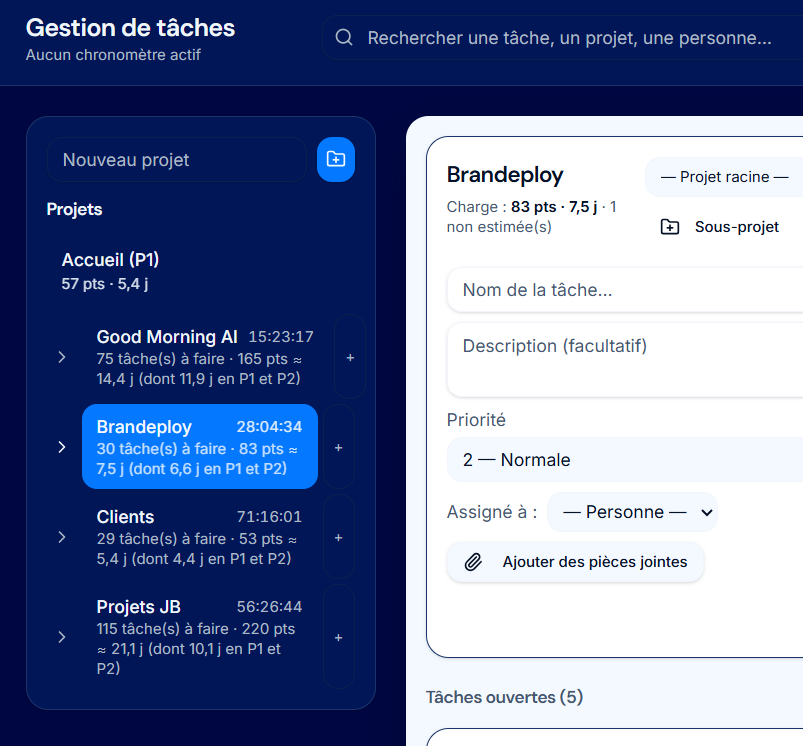
To channel this continuous flow of tasks, using a ticket management tool is essential. While standard market solutions allow for structuring projects and assigning responsibilities, the intensive use of AI has led me to develop my own system. The goal is to pair every idea with immediate decision indicators.
My system is based on two pillars derived from agile methods. On one hand, the priority level defines absolute or relative urgency. On the other, the estimation of the workload allows for quantifying the real effort, thus avoiding underestimating the complexity of an automation or content generation.
- Priority 1: Tasks to be handled immediately.
- Priority 2: Actions to be carried out as soon as possible (ASAP).
- Priority 3: Secondary or exploratory improvements.
- Qualify — Transform each idea or need into a unique ticket.
- Prioritize — Assign an urgency level from 1 to 3.
- Evaluate — Assign a weight in points (1, 2, 3, 5, 8, or 13) according to complexity.
The SCRUM method applied to AI allows for maintaining control over technical velocity.
03
Defining your daily priorities
The risk with AI is believing that you can accomplish everything in a single day. To maintain real efficiency, I strictly limit the volume of Priority 1 tickets. Every morning, before starting any task, I perform a systematic downgrading of tickets to reach an acceptable load.
In my workflow, I stabilize my day around thirty points. This limit forces critical choices and prevents the accumulation of unfinished tasks that clutter mental bandwidth. The tool then transforms these points into dynamic remaining time.
This visual countdown system makes the work engaging. Seeing the gauge decrease as AI tasks are validated creates a dynamic of immediate success. It is the necessary engine to close cases rather than constantly opening new ones.
Organization is the only rampart against operational infobesity.
04
Turning monitoring into a pool of actions
In the artificial intelligence ecosystem, innovation is permanent and often already tested by your competitors or players in other sectors. There is no need to reinvent the wheel. My method consists of daily analysis of market best practices to transform them into actionable tickets.
Every good idea identified in a competitor immediately becomes a task in my backlog. I don't just store the information: I assign it a priority and an estimated workload. This allows for an instant comparison of a new idea's value against already planned tasks.
- Observation of new prompt structures.
- Analysis of conversion tunnels optimized by AI.
- Identification of new formats for generated content.
The faster we work thanks to AI, the richer and more structured the pool of ideas must be to ensure we are always working on the most profitable levers.
Success does not come from the idea, but from its rapid transformation into a prioritized ticket.
05
Analyzing to optimize KPIs
Producing massively with AI is useless if you don't measure the impact of each action. Every new feature or optimization must be accompanied by an analysis plan. My weekly ritual involves reviewing all projects to identify what truly generates business value.
When a simple modification is identified to improve a conversion rate or SEO performance, it is handled instantly. For more complex subjects, the ticketing cycle starts again. This feedback loop allows for adjusting efforts based on real results rather than intuitions.
| Action | Analysis | Decision |
|---|---|---|
| New AI Content | Traffic and Bounce | Optimize or Archive |
| Automation | Time Saved | Maintain or Pivot |
| Ergonomic Test | Click-Through Rate | Generalize or Cancel |
AI allows you to execute, but only analysis allows you to lead.
06
Conclusion: Organization, the cornerstone of AI
Artificial intelligence is a high-powered engine that requires a robust organizational chassis. Without a strict project management method, the productivity offered by these tools quickly turns into operational chaos. The key lies in the ability to prioritize without compromise and to quantify effort.
By using a rigorous ticketing system and limiting your daily load, you regain control over the technology. AI should not dictate your pace; it must serve your strategic priorities validated by analysis.
Operational excellence with AI is born from the meeting of technical speed and human rigor.
Written by

Jean-Baptiste Duquesne
Partner — SEO, GEO & CRM
A web pioneer since 1995 and founder of 750g.com (sold to Webedia). At Good Morning AI he leads SEO, visibility inside generative engines (GEO) and customer lifecycle work.
Published on 20 August 2026
The Good Morning AI newsletter
Daily, or weekly on Tuesday: your choice.
Want to discuss this with us?
30 minutes, a quick call, and we'll see together how we can help you move forward.
Discuss your project